Module 1 of 8 · A List of Your Own
Module 1 - Why the list is the only thing you own
Read: about 13 minutes · Build: about 45 minutes · Week 1
I want to start with an argument rather than a piece of software, because if the argument doesn't land, the software won't help you.
You'll need two free accounts for the build task.
Both links are at the bottom of this page.
You don't need a subject picked out to read this. That question comes at the end, and there's a page for it if it turns out to be the part you get stuck on.
There is a decision that sits underneath everything else in this course. Almost nobody makes it deliberately. Most people fall into one side of it by accident, work hard for six months, get nothing, and conclude they're not cut out for this.
The decision is what you do with a visitor.
What happens to a click
Say you've found something you'd be happy to recommend. A tool, a book, a service - something you actually use and would mention to a friend. The company has an affiliate program, so if someone buys through your link, you get paid.
Now you need people to click that link. However you get them - an ad, a post, a comment, a conversation - there's effort behind every click. Money or time, but never nothing.
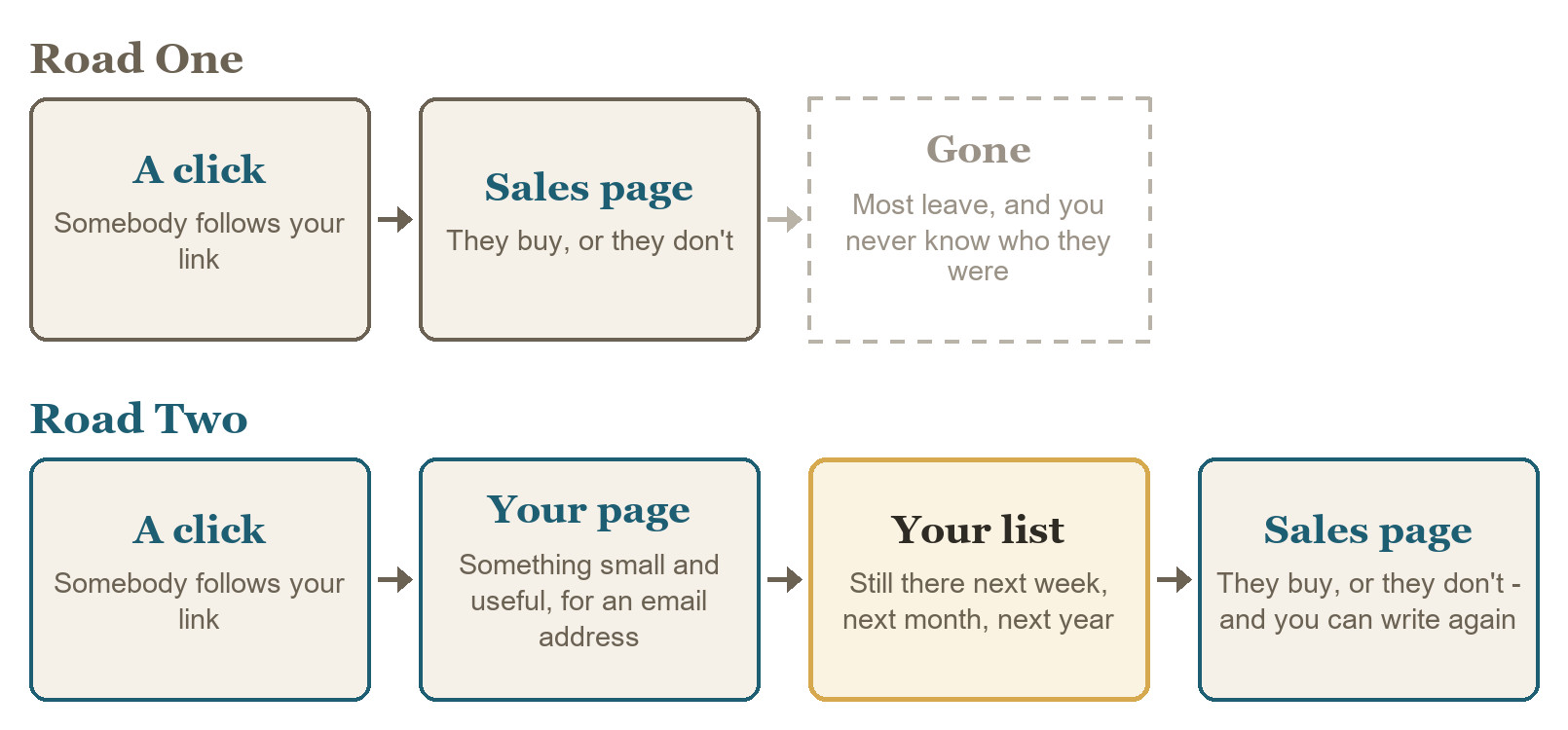
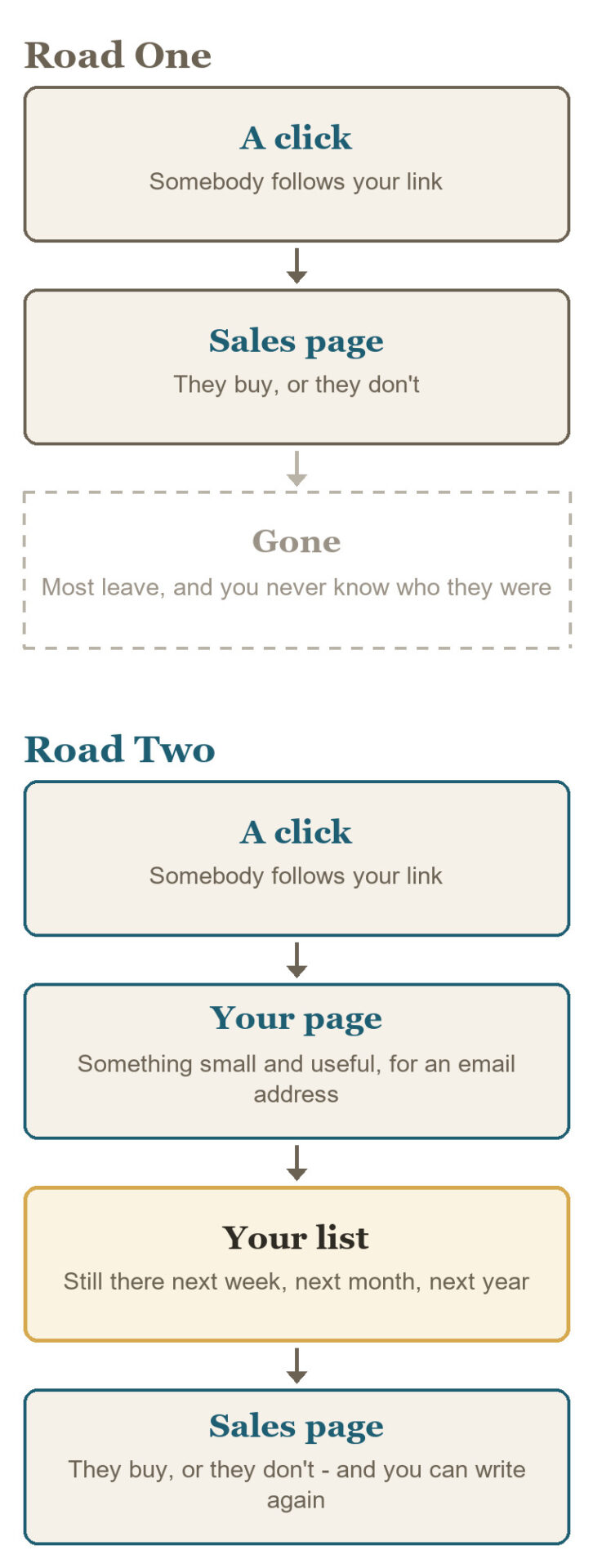
Here's the fork.
Road One
The click goes straight to the company's sales page. The visitor lands, reads or doesn't, buys or doesn't. If they buy, you get paid. If they don't, they close the tab and that is genuinely the end of it. You will never know who they were. You cannot follow up. You cannot try a different angle next week. The click is spent.
Most visitors don't buy, and the reasons usually have nothing to do with you - bad timing, no budget this month, meant to think about it and then forgot. You'll see figures quoted for how many do. Ignore them; nobody knows yours until you've run it. But whatever the number turns out to be, the great majority of your effort produces nothing on road one, and produces it permanently.
Road Two
The click goes to a page of yours first. That page offers something small and useful in exchange for an email address. Some people give it, some don't. The ones who do go onto a list. Then they get sent along to the thing you were recommending anyway.
Road two costs you something real. You have to make the small useful thing. You have to build the page. Some visitors won't hand over an email address and you'll lose sales you would have made on road one. That's a genuine cost and I'm not going to hide it.
What you get in exchange is this: the people who joined are still reachable tomorrow.
The word "own"
The title of this module says the list is the only thing you own. I mean that fairly literally, and it's worth a minute.
Everything else in this business is rented.
If you build an audience on a social platform, the platform decides who sees your posts. That decision changes without warning and without appeal. People who spent years building a following have watched their reach fall by most of it overnight because someone adjusted something. They didn't do anything wrong. They just didn't own the connection.
If you rank on a search engine, the same is true with different clothes on.
If you depend on one affiliate program, that program can close, change its terms, or cut its commission on a Tuesday.
An email list is different in one specific way. You have the addresses. If the platform holding them turns bad - raises its prices, changes its rules, goes under - you export the list and take it somewhere else, and the people on it never notice. The relationship is between you and them. The software is just where it happens to be stored this year.
That is the whole reason a list is worth the extra work, and it's the reason this course only builds one thing.
Draw it out over a year
This is where it stops being a preference and starts being arithmetic.
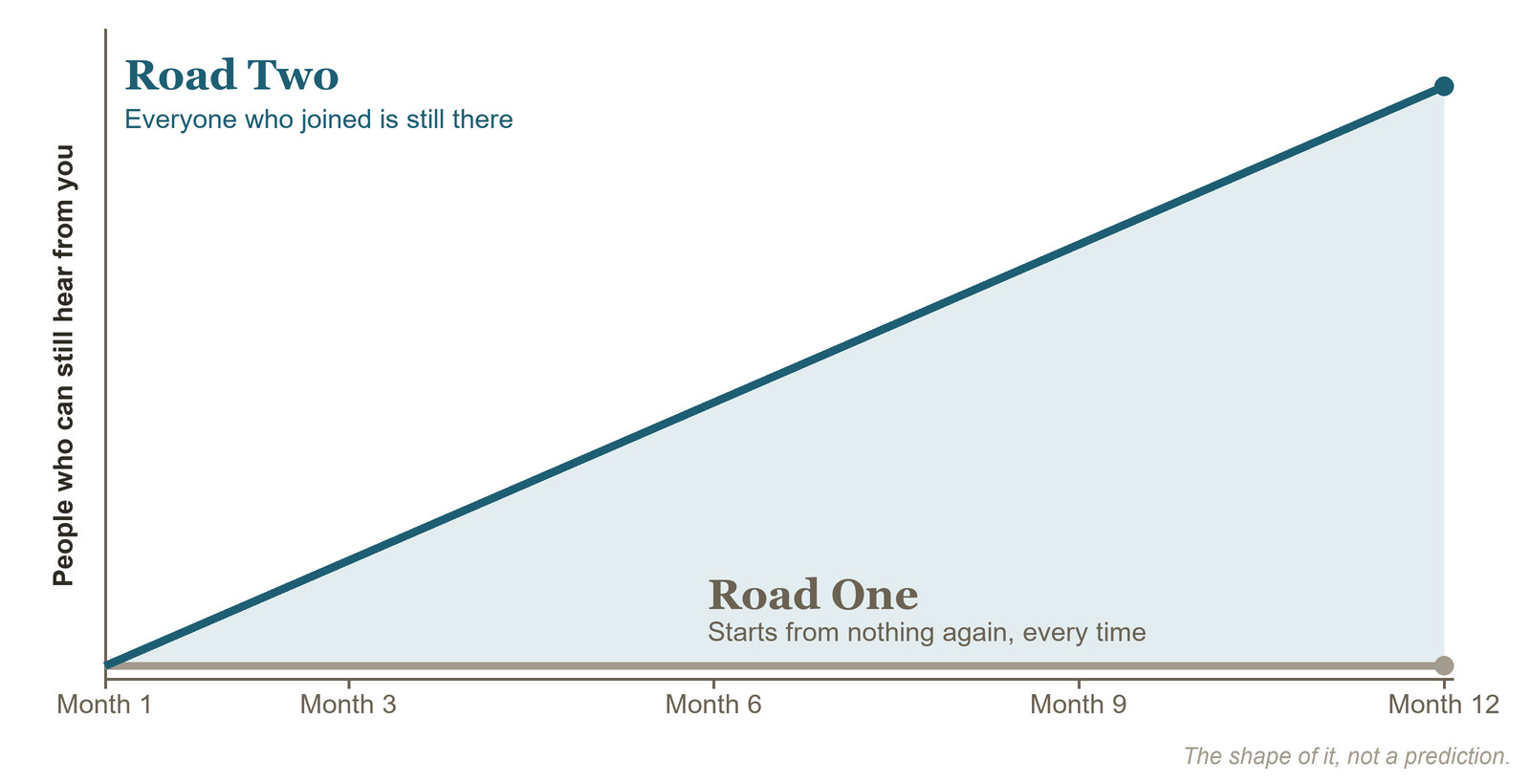
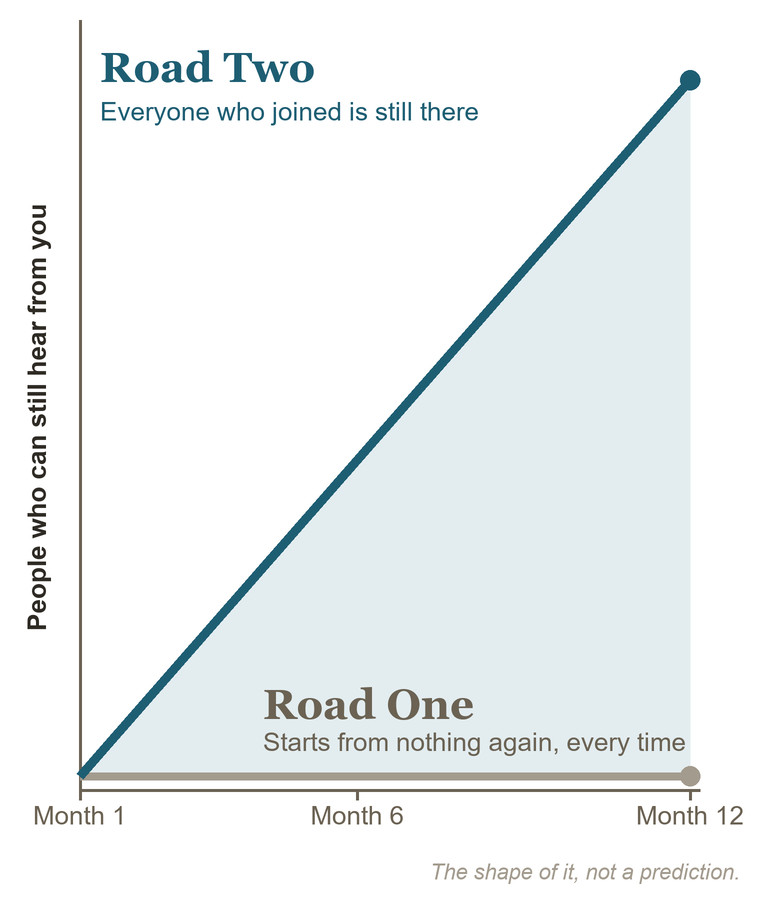
I'm going to use round numbers below. They are illustrative - I picked them because they're easy to follow, not because they predict what will happen to you. What I'm showing you is the shape of the difference. The shape holds no matter what the real numbers turn out to be.
Suppose over a year you manage to send a thousand visitors. Not in a day. Across twelve months, working at it.
On road one, that's a thousand single chances. Each visitor arrives, gets one look at one offer on one particular day, and goes. Your total is whatever those thousand single chances produced. Then the year ends and you start the next one from zero, because you have nothing to carry forward. No visitor from March is available to you in November.
On road two, some fraction of those thousand join your list. I don't know what fraction and neither does anyone else until you run it - it depends on your offer, your page, and who those visitors were. But say it's a few hundred.
Those few hundred people can hear from you again. Next week, next month, in November. If you write to your list once a week, each of them is not one chance but fifty over the year. And the second time someone hears from you, they know your name. The tenth time, they have some sense of whether you're worth listening to. That's not a trick - it's just how trust works, and it's unavailable to you on road one at any price.
Then the next year starts, and road one starts from zero again while road two starts from a few hundred people who already know you.
The gap between the two roads is small in month one. It's small in month three. Then it stops being small, and it never closes again.
"But I don't have anything to sell"
This is the objection I hear most, and it's usually the wrong shape.
You don't need a product. You need something worth an email address - which is a much lower bar. A one-page checklist. A short list of the tools you use. A plain walkthrough of something you figured out that took you a while. That's Module 2, and I'll walk you through making it.
The second half of the objection is usually "and I'm not a writer." Neither were most people who do this well. You need to be able to write the way you talk, which is a different skill from writing well and considerably easier. You can also use AI to help - I do, and I'll show you how in Module 4 without letting it turn your emails into the beige nothing it produces if you just ask it for an email.
If you can explain something to a friend, you have enough.
Now the software
I've held off naming a platform this long deliberately, because I want you to be able to tell the argument from the tool. The argument above is true regardless of what software you use. If you already have something that captures emails and sends them, you can do this course with that and ignore the rest of this section.
For everyone else: you're going to use two programs, not one. I want to say that before you sign up for anything, because most courses in this corner of the internet will tell you one tool does everything, and there's usually a reason they say so.
Building a list needs four pieces. Somewhere to put a page. Somewhere to keep the addresses. A way to send emails automatically, so they go out whether you're at the computer or not. And some source of visitors.
Normally that's three or four separate services with three or four monthly bills, and the bills start before you've earned anything. So a free tool that does all four is an appealing thing to find, and I went looking for one.
There isn't one. Not a free one.
I should tell you how I know that. I wrote most of this course with LeadsLeap doing all four jobs, because that's what I was using and it looked like it worked. Then I got far enough in to find that the automatic sending is on the paid plan only. I could have left it there and let you discover it in week five. That's what was done to me, in the course I bought before I wrote this one.
What there is, is two free tools that each do part of it well.
Systeme.io holds your page, keeps the addresses, and sends the emails automatically. Three of the four jobs, one login, free up to 2,000 subscribers, and the free plan doesn't expire.
LeadsLeap is where your first visitors come from. You show your ad to other members, and you earn the right to do that by viewing theirs. It costs time instead of money, and I haven't found anything else that gives a beginner visitors without a card.
I'm an affiliate for both, and you should know that before you read another sentence. Neither pays me anything when you open a free account - they pay only if you upgrade later. It doesn't cost you more either way, and it isn't why I picked them.
The honest cost of doing it this way is two logins and two sets of screens to learn. That's real, and I'm not going to pretend otherwise. What you get for it is software that stays free. You won't get to week five and find the next step needs a credit card.
If you'd rather have one login than two, there's a straightforward way to get it. LeadsLeap does all four jobs by itself on its paid plan, at $27 a month. Everything this course teaches works that way too, though some of the screens I describe will look different from the ones in front of you.
That's a real choice, not a nudge. I'd rather you spent nothing until you know whether this works for you.
There's a third way as well, without LeadsLeap at all. If you'd like to see all three side by side before you start, they're on the options page.
Four jobs, five screens
Two programs, and between them five screens you'll actually open. Everything else on either menu can wait.
In Systeme.io
Sales funnels. Where you build the page that asks for the email address. It sits under Sites. That's Module 3.
Contacts. Where the addresses live once people give them to you. Under CRM.
Campaigns. The emails that go out automatically after somebody joins. Under Emails. Modules 4 and 6.
In LeadsLeap
Post Credit Ads.Where your visitors come from. You show your ad to other members, and you earn the right to do that by viewing theirs. It sits under Traffic. Module 5.
Track Links. Tells you how many people clicked what. It sits under Tracker. Sounds optional and isn't. In Module 7 you'll use it to work out whether a disappointing result is a traffic problem or an offer problem - completely different problems, completely different fixes, and most people guess wrong.
Five screens. That's the entire course.
The honest cost of "free"
I said both programs are free. That's true, there's a ceiling on each of them, and I'd rather you knew the shape of them in Module 1 than met one in Module 5.
Systeme.io's ceiling is size. The free plan holds 2,000 subscribers. That's a long way from where you're starting, and it isn't unlimited. It also puts a small "Sent with systeme.io" line at the bottom of your emails, and paying is the only way to remove it.
LeadsLeap's ceiling is time. On the free account you earn traffic rather than buying it. In practice that means sitting down once a day and viewing other members' ads to build up credits, which are then spent showing your ad to them. You want to do that for at least 10 minutes. I do 100 ads with my morning coffee, which takes 30-45 minutes.
That's a real cost. It's time instead of money. If you have more time than money - which is most of the reason you might be reading this - it's the better trade, but it isn't nothing, and it's a daily habit rather than a one-off.
Both have paid plans, and I named one of them above: LeadsLeap's, at $27 a month, which does the whole course on its own if you'd rather keep one login than two. I'm not going to push you at it. In Module 5 you'll start keeping a simple log - the minutes you spend, and the visitors they bring. By Module 7 you'll have a couple of weeks of your own numbers, and you'll be able to work out what that time is actually buying you. Some people should pay. Some should carry on as they are. I don't know which one you are, and I'd be making it up if I told you today.
What I can promise is that the tools don't start free and quietly turn paid halfway through. The course costs $17 after Module 3, and I've said so from the first page you read. The software stays free the whole way to the end. That's the part that happened to me, in the course I bought before I wrote this one, and it's most of the reason this exists.
And everything else
Everything else on those two menus can wait until the later modules.
I mean that as permission, not as criticism. Some of the other tools are genuinely good. But a tool is only useful when there's something for it to point at, and right now there isn't. Opening them today will cost you an afternoon and give you nothing, and worse, it will leave you with the feeling that this is more complicated than you can manage - which is the feeling that ends most attempts.
Later, you'll come back to those menus with a working system, and about half of those items will suddenly make obvious sense. The other half still won't be for you. Both of those are fine.
For now: five screens. Walk past the rest.
Your build task
Three things, about 45 minutes.
1. Create your two free accounts. Both free, Systeme.io and LeadsLeap, neither needs a card. Confirm your email address on each and log in.
2. Find the five screens. Not use them - find them. In Systeme.io, open Sales funnels, Contacts, and Campaigns. In LeadsLeap, open Post Credit Ads and Track Links. Click into each one, look at it for thirty seconds, come back out. The point is that when Module 3 says "open Sales funnels," you already know where it is, and it isn't a new thing on top of a new thing.
LeadsLeap and Systeme.io both update their screens from time to time, so yours may look a little different from the picture. The words on the buttons usually stay the same - look for those.
3. Write one sentence. This is the small task that takes the most time, and it drives every decision in Modules 2, 3 and 4.
The sentence is: I help [who] with [what], because [why me].
Who you want to help, and what you want to help them with. One sentence. Nobody else will see it. It doesn't need to be clever, and it can change later.
Some examples of the shape:
Notice that none of those are "I help people make money online." That sentence fails the test, for two reasons. It names no one in particular, so nothing you make from it will feel like it's for anybody. And it's the single most crowded sentence in this entire industry.
The test for a good sentence is simple: could you picture one specific person it describes? Not a category - a person. Someone you know, or someone you were five years ago. If you can see them, the sentence works. If you can't, it's still too broad, and narrowing it will feel like it's shrinking your audience when what it's actually doing is making it possible to say something.
If you're looking at that blank and nothing is coming, you're in the most common sticking point in this course. It isn't a shortage of ideas. It's that almost nobody can answer "what am I an expert in" about themselves.
What you already know asks easier questions - what people used to come to you about, what you had to learn the hard way. Work through it, then come back and fill in the blanks.
Write it down somewhere you'll find it again. You'll need it next week.
Pro Tip
Make a bookmark folder in your browser called My List and put the Systeme.io and LeadsLeap login pages in it. When your browser offers to save each password, say yes. Every module from here starts with "open Systeme.io" or "open LeadsLeap", and one click beats hunting for a tab.
What happens next
Module 2 is about making the small useful thing that people will give you an email address for. It's the biggest single build in the course - three or four hours - and it's where the sentence you just wrote turns into something real.
Before you go: if you did the two accounts and the five screens but skipped the sentence because it felt like homework rather than progress, go back and do the sentence. It's the one that matters. The other two take fifteen minutes and I'd rather you did them next week than skipped this one.
Talk soon, Bob